



An Employee's Right to Continue Workplace Health Insurance
Federal law requires most employers to offer continued health insurance to employees and their families after certain qualifying events. This means that if someone loses their job or has their hours cut, the employer must give them the option to stay on the health plan for a period of time, even though they are no longer working full-time.
The COBRA legislation allows people to keep their employer health insurance for a limited time after certain life changes, like losing a job or having work hours reduced. This helps individuals and families stay insured while they manage the transition. COBRA has helped millions of Americans maintain access to healthcare if it would otherwise have stopped.
Consolidated Omnibus Budget Reconciliation Act Overview
The Consolidated Omnibus Budget Reconciliation Act (COBRA) was signed into law by President Ronald Reagan on April 7, 1986, as part of a larger budget bill aimed at reducing the federal deficit. Sponsored by Representative Pete Stark of California, COBRA was created to address the need for employees and their families to have health insurance during periods of job loss or transition.
To qualify for COBRA, individuals must have been enrolled in their employer’s health plan on the day before a qualifying event. Additionally, the employer must have had at least 20 employees who worked over 1,000 hours in the previous calendar year.
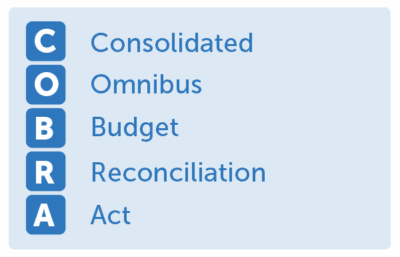
COBRA is an Abbreviation
COBRA is an abbreviation, often mistaken for an acronym, that stands for the Consolidated Omnibus Budget Reconciliation Act. The term is often used as shorthand for the federal law allowing employees and their families to keep their health insurance after job loss or other qualifying events.
Federal Oversight
The federal government oversees COBRA through two agencies: the Department of Labor (DOL) and the Department of Health and Human Services (HHS). The DOL ensures employers follow COBRA rules, while the HHS makes sure COBRA coverage meets the standards of the Affordable Care Act.
H.R. 3128 – Consolidated Omnibus Budget Reconciliation Act of 1985
The Consolidated Omnibus Budget Reconciliation Act of 1985 (COBRA) is a broad federal law that includes provisions on health insurance continuation. The legislation outlines specific sections that define employer responsibilities and explain the rights and obligations of employees.
Provisions and Employer Requirements
The following is an explanation of the Consolidated Omnibus Budget Reconciliation Act (COBRA) as it relates to the continuation of employer-sponsored group health plans:
- Section 601. Requires employers with 20 or more employees to offer continued health insurance coverage to employees and their dependents who lose coverage due to certain qualifying events, such as termination of employment, reduction in hours, death of the employee, divorce, or a dependent child becoming ineligible.
- Section 602. Sets the requirements for providing continuation coverage, including how long coverage must be offered, premium responsibilities, and notice obligations.
- Section 602(a)(1). Scope of Continuation Coverage. Requires that continuation coverage be identical to the group health plan coverage in effect immediately before the qualifying event, including the same benefits, providers, and service levels.
- Section 602(a)(2). Required Coverage Period. Establishes that continuation coverage must be offered for a minimum period of 18 months for qualifying events such as termination of employment or reduction in hours, with longer periods available for certain events or extensions.
- Section 602(a)(3). Premium Cost Responsibility. Allows employers or plan administrators to charge qualified beneficiaries up to 102 percent of the full group health plan premium, which includes the employee share, the employer share, and up to a 2 percent administrative fee. In certain disability extensions, premiums may increase to 150 percent after the initial 18-month period.
- Section 602(a)(4). Notice of COBRA Rights. Requires employers or plan administrators to provide written notice informing qualified beneficiaries of their COBRA continuation rights within 60 days of the qualifying event.
- Section 603. Establishes a process for employees and dependents to appeal a denial of coverage. Appeals must be filed with the Department of Labor within 60 days of the denial.
- Section 604. Provides for enforcement by the Department of Labor, which may bring civil action against employers who violate the law.
Frequently Asked Questions
COBRA was enacted in 1986 as part of the Consolidated Omnibus Budget Reconciliation Act, a federal budget bill signed by President Ronald Reagan. The continuation coverage provisions were included to address gaps in health insurance coverage caused by job loss, reduced work hours and other employment-related changes. Lawmakers aimed to prevent sudden loss of coverage for workers and their families during transitions.
COBRA is not a separate health insurance plan. It is a legal right under federal law that allows qualified beneficiaries to temporarily continue participation in an existing employer-sponsored group health plan after a qualifying event. The coverage remains governed by the employer’s plan terms and ends when the maximum continuation period expires or the plan itself terminates.
Under federal law, COBRA applies to private-sector employers and state and local governments that employed at least 20 workers on more than 50 percent of their typical business days in the previous calendar year. Federal government plans and most church-sponsored plans are excluded from COBRA requirements.
COBRA requires that continuation coverage be identical to the group health plan coverage in place immediately before the qualifying event. This includes the same benefits, provider networks and plan rules. Employers may not offer reduced or substitute coverage for individuals electing COBRA.
The law permits employers or plan administrators to charge up to 102 percent of the full group health plan premium to cover both the total cost of the plan and administrative expenses. Congress included this provision to ensure employers were not financially penalized for offering continuation coverage while still preserving access to employer-sponsored plans for former employees and dependents.
Mini-COBRA in Some States
For smaller businesses not covered by the federal mandate, many states have created their own continuation rules, often referred to as Mini-COBRA laws. These state-level protections generally apply to companies with 19 or fewer employees and vary depending on where you live.
While the specific rules differ by state, most follow a similar structure to the federal requirement—offering temporary access to group health coverage after job loss or other qualifying events. Find your your state’s health insurance continuation law and how they affect your medical coverage.
About COBRAInsurance.com
When your job ends, your health insurance doesn’t have to. At COBRAinsurance.com, we help you explore affordable coverage options during life’s in-between moments.
We’re a licensed insurance company that guides people through what comes next after employer coverage ends. From understanding COBRA to finding the right plan.
If you are looking for an alternative to COBRA, we can help.